
Platform Integrated restoration technology
One integrated restoration platform.
Site intelligence, engineered Seedpods, precision UAV deployment and TerraSight monitoring — four capabilities on one data record, judged by what establishes.
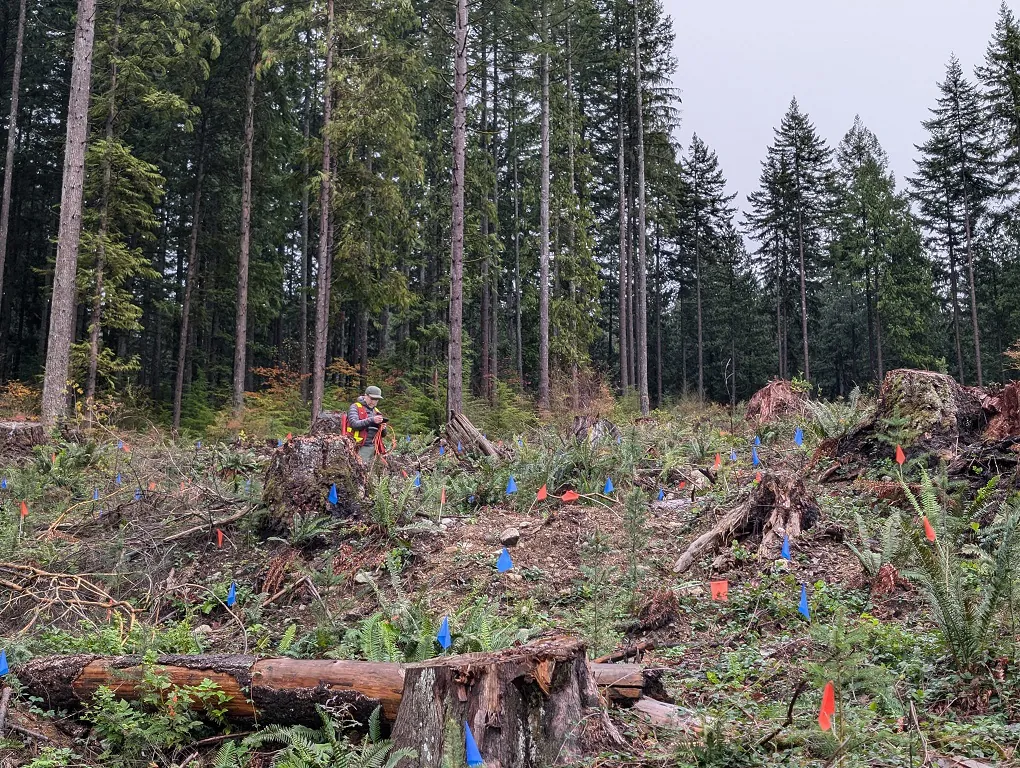
01 Assess · Site Intelligence
Know the site before anything flies.
We review terrain, access, site conditions and restoration objectives to decide whether — and how — Seedpods and UAV deployment fit.
- Treatment areas defined from approved polygons
- Terrain, access and safety constraints reviewed
- Species and prescription support
- A clear fit / no-fit call before deployment
02 Engineer · Seedpod Technology
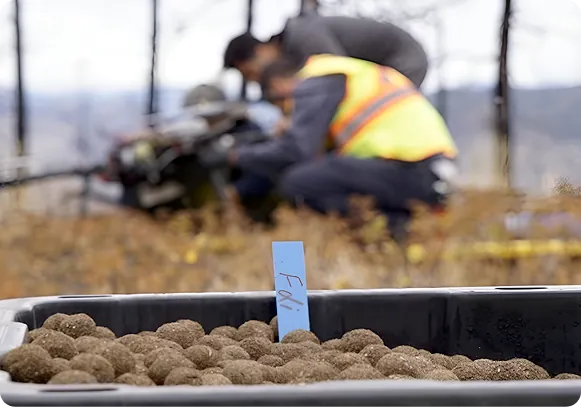
Engineered for real field conditions.
Species- and site-specific Seedpods that protect seed, support early establishment and deploy reliably at scale.
- Formats adapted to each species and site
- Batch-manufactured with QA/QC
- Field-deployed for conifers and native grasses
- Published patent application WO2026/093791
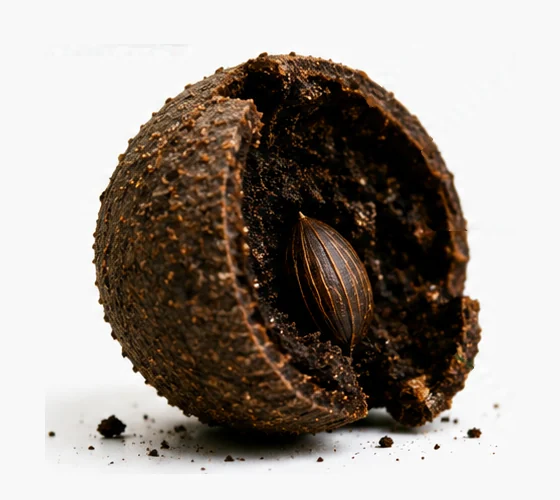
Inside a Seedpod
- Protective shellShields the seed from impact, predators and harsh conditions.
- Moisture supportAbsorbs and releases moisture for early establishment.
- Native seedSpecies-specific seed matched to the site.
- Nutrient supportFeeds early root and shoot growth.
03 Deploy · Precision Deployment
Precision deployment for difficult-access land.
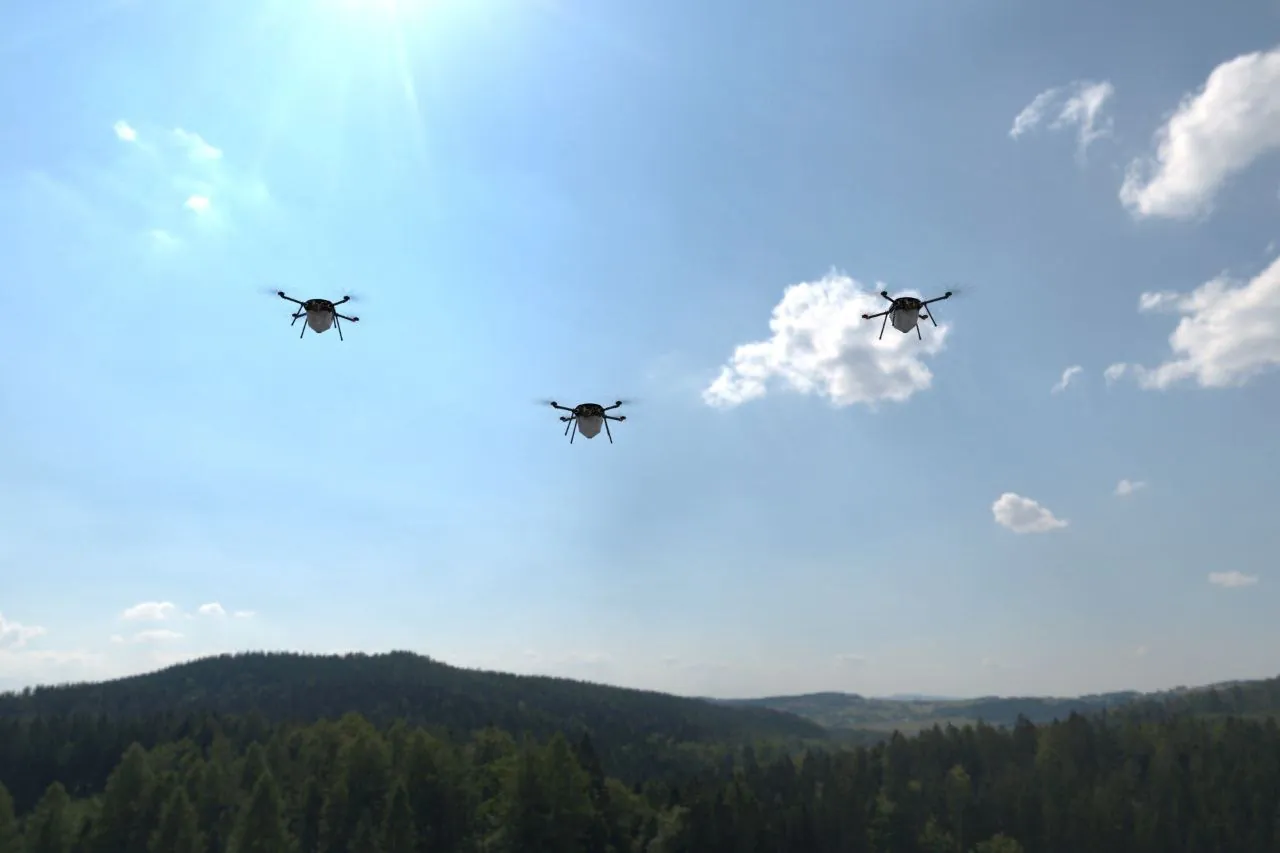
Approved treatment areas become georeferenced UAV operations — across remote, burned or steep terrain.
- Treatment plans built from approved polygons
- Controlled application density
- Recorded flight paths, material use and completion
- Operated under Canadian RPAS requirements
- Dispensing system: patent application WO2026/093790
04 Verify · TerraSight Monitoring
Turn imagery into measurable outcomes.
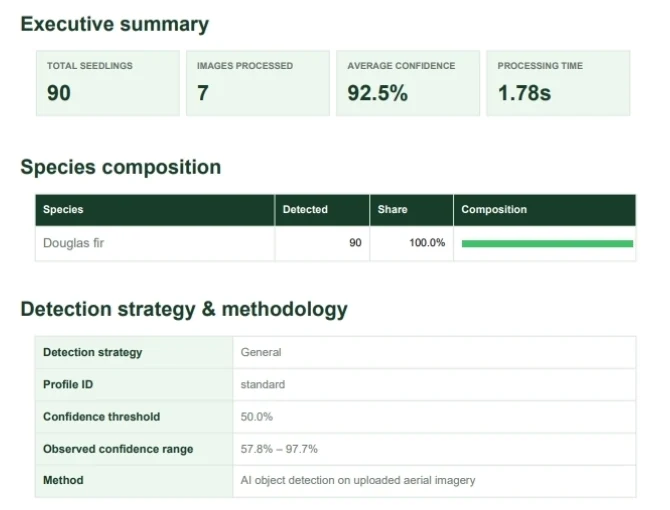
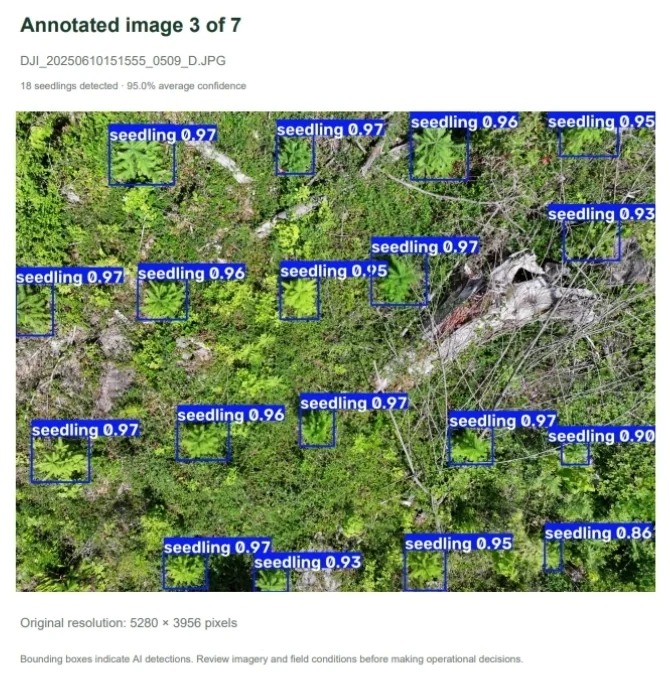
TerraSight tells your team how to capture UAV imagery, then turns it into establishment and vegetation reports — no TreeTrack crew required.
Screen recording of TerraSight on field UAV imagery · sped up
Sample deliverable · PDF report pages (test imagery)
05 Evidence
Measured after deployment.
Every figure comes with its scope. Results vary by species, site, format and season.
- ~200haTreated in documented deployments, 2023–261
- 440kSeedpods produced for one deployment, Quebec 20262
- 46%132 of 287 sampled Seedpods had a living seedling at 23 months3
- 88.6%132 of 149 seedlings alive at the 2024 baseline survived to 20264
- 99.7%Lower operational emissions, assessed LCA5
| Dimension | Hand planting | Broadcast aerial seeding | TreeTrack |
|---|---|---|---|
| Steep, remote or burned terrain | Limited by crew access and safety | Wide reach, little control over placement | Georeferenced UAV treatment plans |
| What is delivered | Nursery-grown seedlings | Seed spread across the area | Engineered, species-specific Seedpods |
| Operational emissions | Comparator in the Brightspot assessment | Not assessed by TreeTrack | 99.7% lower in the assessed scenario5 |
| How outcomes are measured | Survival surveys | Varies by program | Field and UAV establishment monitoring |
- Hectares treated — sum of documented completed deployments: Shackan 11 / Tree Canada, Nicola Watershed (30 ha, Oct 2023); Western Forest Products / BC Ministry of Forests, Port Hardy (~36.3 ha, Apr 2024); Ntityix Resources / Westbank First Nation, West Kelowna (6 ha, May 2025); Dunkley Lumber, Quesnel (~2.2 ha, Jun 2026); FPInnovations, Selbaie, Quebec (~125–128 ha, Oct–Nov 2026). Excludes Canfor’s 33.9 ha contracted scope and an 18 ha spring 2026 Vancouver Island program pending an overlap check. “Treated” does not mean restored. ↩
- Seedpods produced — ~440,000 Seedpods, mainly black spruce and jack pine, produced for the FPInnovations Selbaie deployment. Production can differ from the final deployed count. ↩
- Living seedlings at 23 months — Malcolm Knapp Research Forest, Maple Ridge, BC. Deployed Sep 9, 2024; independent baseline Oct 28, 2024 (Cariboo Carbon Solutions); TreeTrack follow-up Aug 10, 2026. 132 of 287 sampled Seedpods (46.0%) had a living seedling. The follow-up has not been independently verified. ↩
- Seedling survival — same trial: of 149 seedlings alive at the 2024 baseline, 132 were alive in August 2026 (88.6% seedling survival). For comparison, a 2024 Thompson Rivers University greenhouse trial reached 82% for ponderosa pine and 56% for Douglas-fir in spherical Seedpods — greenhouse results, not field establishment. ↩
- Operational emissions — 99.7% lower within the scope and comparator defined in the Brightspot life-cycle assessment; the same scenario showed 274 tCO₂e lower per 100 ha versus hand planting. Not a universal figure. ↩
Research & patents
- Seed encapsulation improves early recruitment in seed-based restorationChaieb & Fraser, Thompson Rivers University · Ecological Solutions and Evidence, 2026 · peer-reviewed field study: pods outperformed pelleted seed on emergence and survival
- WO2026/093791Multi-layer Seedpod and manufacturing method · published international patent application
- WO2026/093790Seedpod dispensing system for precision UAV deployment · published international patent application
See the system on your land.
Share the site, approximate area and objective.